
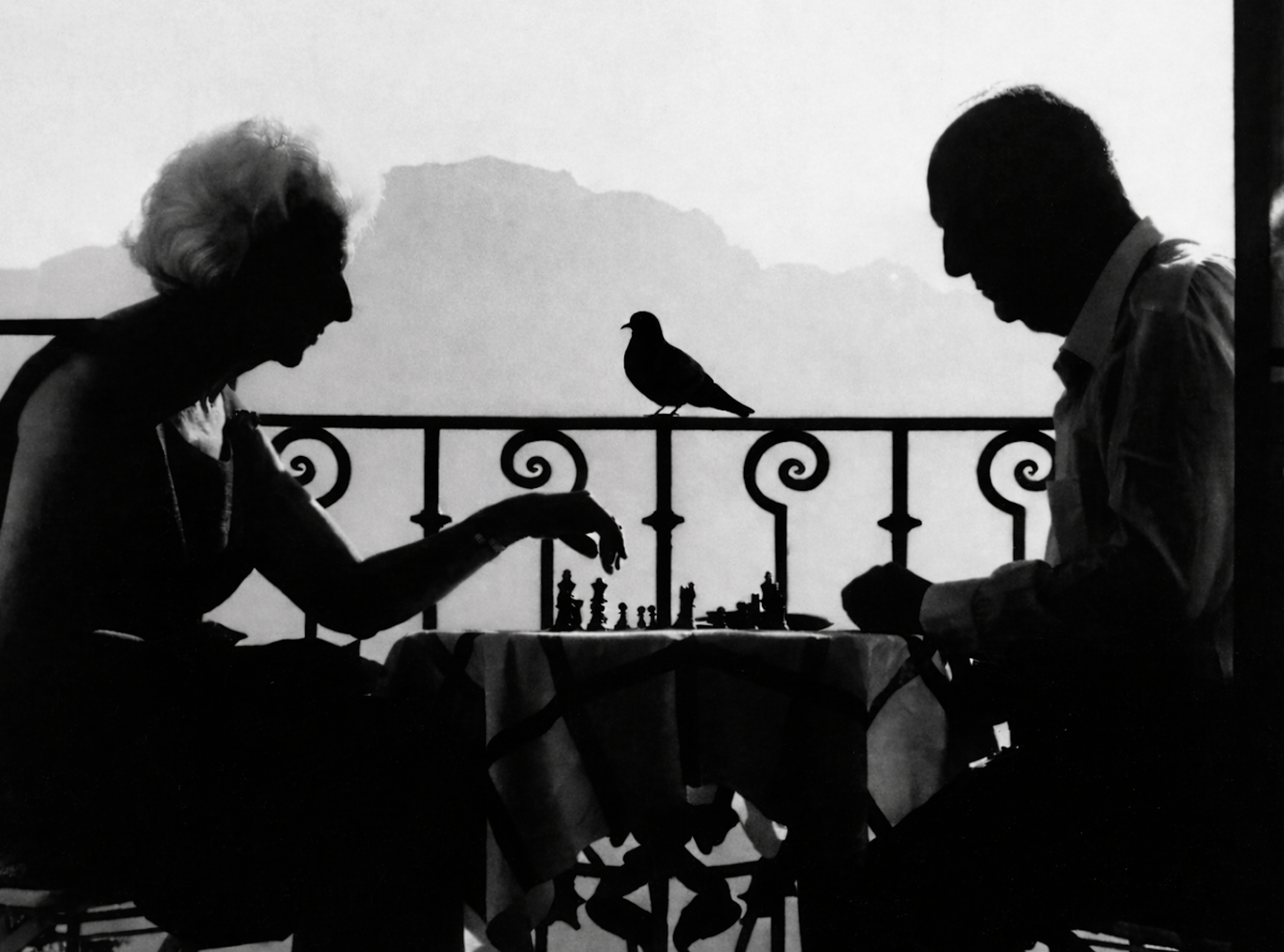
The great Russian-American novelist Vladimir Nabokov (1899-1977) produced, across more than fifty years, a series of works that meaningfully shaped the literature of the twentieth century. Polyglot, intricate, suffused with trickery and earnest passion, his masterpieces (Lolita, Pale Fire, Ada) dazzle and dismay in equal measure. Was he a “Bird”? The question is addressed, obliquely, in a collectively-authored essay published in the Proceedings in 2012 (“‘Fix Your Eyes Right Here!’ The Life and Times of Inyard Kip Ketchem, the Performing Attention Doctor,” New Series IV, Vol. 2 [2012]: 63–91; and republished as Chapter 12 of In Search of the Third Bird), where the affecting image of the “shadow” of the “waxwing” that is “slain | By the false azure in the windowpane” (from the opening of Pale Fire) is read as a figure for the problems of association with, and alienation from, the Avis Tertia.
But more elaborate efforts to plot Nabokov’s relationship to the Order have, from time to time, surfaced (see, inter alia, Alexey Sklyarenko’s remarkable “annotation” on a series of avian tropes in Ada and other works, published in the Nabokovian; or the virtuosic identification of more than eighty bird species in the oeuvre as a whole, the achievement of Johan Warodell, originally published in Nabokov Studies). Nevertheless, a definitive treatment of the subject is still wanting.
A recent communication from an ESTAR(SER) affiliate in Iceland opens a new line of inquiry into this longstanding question, and we reproduce it here below in full.
I found myself lately back in Nabokov’s Transparent Things (1972), a work I experience as a tiny, perfect Swiss watch, the movement of which makes minute and whirring cycles within a jewel-case. Some of your readers may be familiar with the plot: a rather bumbling and callow literary editor (Hugh Person) is followed on a set of four interlocking sojourns to Switzerland, each entangled in some banal or monstrous crossing of sex and death; only in retrospect does it become clear (or does it?) that the whole book has been narrated by a ghost — evidently the ghost of a rather “grand” author who has himself been a troublesome character across much of the tale. Time, it turns out, is lucently visible to the dead, who look on a world of thin surfaces. Always, everywhere, all that has come before roils into view for them, and they struggle to stay with the frank appearances that we, the living, time-bound as we (mostly) are, cannot get past.
So far, so Nabokovian. But on this read, I was quite bowled over in Chapter 3, by the explicit invocation of the specifically attentional character of this kind of ghost-perception. The chapter in question consists of one of the great set-pieces of the book, in which Hugh Person encounters a commonplace pencil in the drawer of the small, cheap desk in the corner of his sad hotel room. We get little sense that “Person” even notices the pencil, really. But the narrator embarks on an astounding attentional reverie, in which the entire history of the pencil gradually unfolds: the tree felled for its wooden casing; the mixers of the graphite clay to be formed into its lead; the rendering of the grease used to slick its cylinder (and, indeed, a moment with the father of the shepherd who raised the sheep slayed for that fat).
This extraordinary excursus begins with a single sentence, which can be understood as the incantatory ghost-spell that opens onto all hidden worlds: “Now comes the act of attention.”
What leapt out for me in all this was the uncanny similarity between the pencil reverie and what I feel I understand of the experiences of those who have caught a glimpse of the so-called “M’GHIE SIGHT” associated with the “Corona of Care” Protocol of the Avis Tertia. In this practice, adepts are said to achieve a kind of “attentional vision” which spontaneously surfaces the entire history of the object in question (I am here relying, in part, on the account offered by Cisco T. Laertes and Eigil zu Tage-Ravn in their 2021 essay on the topic).
How could the pencil chapter of Transparent Things NOT be an instance of this particular form of Birdish Attentional “Second Sight”? And if this is right, what are the larger implications for our understanding of Nabokov’s relationship to the Order?
That opens onto a much larger set of questions, that I shall not hazard here. But I would note that, to my knowledge, no critic or scholar has ever delved into a basic biographical issue that would surely shed light on these matters. After all, the youthful Vladimir Nabokov read literature (and a bit of zoology, of course) at Cambridge University between 1919 and 1922, in the very heyday of the so-called “Sevens” — that club of clandestine aesthetes known to have been a Bird-affiliated cohort! Does it not seem more than likely that the ambitious and cosmopolitan young author would have fallen in with that set in those years? More work is surely needed.
It is, truly, a lead worth following. And readers wanting to know more about the “Sevens” may consult: The Sevens Working Group, “The Fitzwilliam Schism: Practical Criticism and Practical Aesthesis in Britain and Beyond, 1925–1975,” Proceedings of ESTAR(SER) New Series V, Vol. 4 (2013): 90–110.
Relevant correspondence, is, as ever, invited: esthetical.society@gmail.com.